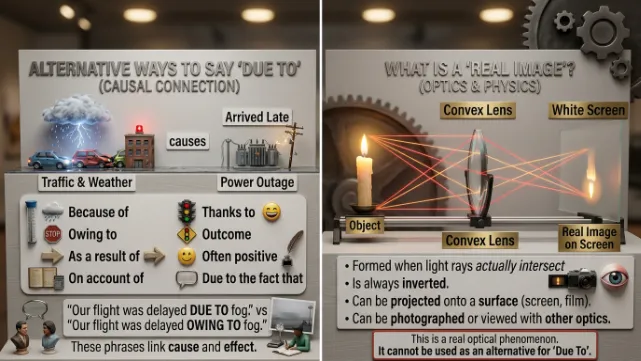
The phrase another way to say due to is useful when you want to avoid repeating the same words in your writing or speech. While “due to” is correct and common, using it too often can make your sentences sound repetitive.
If you’re writing an email, school paper, business report, blog post, or social media caption, knowing different ways to say “due to” helps your writing sound smoother and more natural.
In this guide, you’ll discover over “80 alternatives to due to“, organized by different situations. You’ll also get practical tips to help you choose the right phrase every time.
Formal Alternatives to Due To
Formal writing often requires professional and polished language. These alternatives work well in essays, reports, emails, and business documents.
Examples
- Because of
- Owing to
- As a result of
- On account of
- Thanks to
- As a consequence of
- In light of
- In response to
- In view of
- Following
- Stemming from
- Resulting from
- Arising from
- Attributable to
- Caused by
- Triggered by
- Prompted by
- Brought about by
- Influenced by
- Connected with
- Linked to
- Related to
- Originating from
- Deriving from
- In consequence of
Everyday Ways to Say Due To
In daily conversations, simple phrases sound more natural than formal ones.
Examples
- Because of
- Since
- Thanks to
- From
- After
- Because
- For that reason
- That’s why
- As a result
- Thanks to that
- Owing to that
- Because this happened
- Due to this
- Since that happened
- Because it happened
- After that
- For this reason
- That’s the reason
- Because of that
- From that
- Since then
- As things happened
Creative and Expressive Alternatives to Due To
If you want your writing to sound more interesting or emotional, these expressions add personality.
Examples
- All thanks to
- Blame it on
- Credit goes to
- It happened because
- One thing led to another
- Everything changed because of
- The reason was
- It all started with
- It came from
- The cause was
- That sparked
- That created
- That opened the door to
- That made possible
- That pushed
- That inspired
- That encouraged
- That resulted in
- That turned into
- That paved the way for
- That set things in motion
- That caused everything
Another Way to Say Due To in Academic Writing
Academic writing should be clear, objective, and professional. These alternatives fit essays, research papers, assignments, and reports.
Examples
- As a result of
- Owing to
- Attributable to
- In light of
- In view of
- As a consequence of
- Resulting from
- Stemming from
- Arising from
- On account of
- Because of
- Linked to
- Related to
- Connected with
- Prompted by
- Triggered by
- Influenced by
- Caused by
- Following
- In response to
- Originating from
- Deriving from
Another Way to Say Due To in Business and Professional Emails
Professional communication should sound polite and confident. These alternatives help you explain reasons without repeating the same phrase.
Examples
- Because of
- Following
- In light of
- Owing to
- As a result of
- Due to recent changes
- Based on
- In response to
- Considering
- In accordance with
- In relation to
- Connected with
- Regarding
- Since
- As circumstances changed
- In view of
- Triggered by
- Prompted by
- Related to
- As discussed
- Following our conversation
- As previously mentioned
Another Way to Say Due To for Positive Situations
When the reason is something good, choose words that sound appreciative and optimistic.
Examples
- Thanks to
- All thanks to
- Because of
- With the help of
- As a result of
- Thanks in part to
- Credit goes to
- Inspired by
- Supported by
- Encouraged by
- Made possible by
- Helped by
- Backed by
- Powered by
- Driven by
- Boosted by
- Strengthened by
- Guided by
- Improved through
- Benefiting from
- Assisted by
- Enabled by
Another Way to Say Due To for Negative Situations
Some alternatives work better when explaining problems, setbacks, or unfortunate events.
Examples
- Because of
- Owing to
- As a result of
- Caused by
- Triggered by
- Brought on by
- Stemming from
- Resulting from
- Arising from
- Linked to
- Connected with
- Blame it on
- Prompted by
- Influenced by
- Following
- In consequence of
- On account of
- Originating from
- Due to unexpected circumstances
- Because this occurred
- As things unfolded
- After the incident
Another Way to Say Due To in Customer Service
When speaking with customers, it’s important to sound polite, clear, and understanding. These alternatives help explain reasons without sounding repetitive.
Examples
- Because of
- As a result of
- Owing to
- Due to current demand
- Due to high order volume
- Following your request
- In response to your inquiry
- Based on your feedback
- Because of maintenance
- Due to system updates
- In light of recent changes
- Because of shipping delays
- Thanks to your patience
- Following company policy
- Because of unexpected issues
- As circumstances require
- Due to limited availability
- Because of weather conditions
- In accordance with our policy
- As requested
- Due to technical difficulties
- Because of temporary disruptions
Another Way to Say Due To in Social Media Captions
Social media captions should feel natural and engaging. These phrases keep your posts fresh and conversational.
Examples
- Because of
- Thanks to
- All thanks to
- Since
- That’s why
- For this reason
- As a result
- Because this happened
- One thing led to another
- It all started with
- Thanks for making it happen
- Inspired by
- Fueled by
- Powered by
- Made possible by
- Because life happens
- Following this moment
- After everything
- Because every moment matters
- Thanks for the love
- Thanks for the support
- Because dreams come true
Another Way to Say Due To in Storytelling
Good storytelling often needs different ways to explain why something happened. These alternatives make your stories more interesting.
Examples
- Because of
- It all began with
- As fate would have it
- One event led to another
- Thanks to
- As a consequence of
- The reason was
- It happened because
- Following that moment
- Everything changed after
- Sparked by
- Inspired by
- Driven by
- Prompted by
- Triggered by
- Set in motion by
- Caused by
- Born from
- Shaped by
- Influenced by
- Fueled by
- Created through
Another Way to Say Due To for Presentations and Speeches
Whether you’re speaking at work, school, or an event, these alternatives help your presentation sound polished and professional.
Examples
- Because of
- As a result of
- Owing to
- In light of
- Thanks to
- Following
- As you can see
- For this reason
- Based on these findings
- In response to
- Stemming from
- Resulting from
- Attributable to
- Influenced by
- Prompted by
- Caused by
- Connected with
- Related to
- Due to these factors
- Considering this
- Therefore
- Consequently
Short Alternatives to Due To
Need quick replacements? These short options work perfectly.
Examples
- Because of
- Since
- From
- Via
- Through
- Thanks to
- After
- By
- With
- Following
- Amid
- During
- Over
- Upon
- Via that
- Because
- So
- Thus
- Hence
- Therefore
- Consequently
- Accordingly
Tips for Using Due To Alternatives
- Choose formal alternatives for professional writing.
- Use simple words in everyday conversations.
- Pick positive phrases like thanks to only for good situations.
- Use because of when you want the easiest and most natural option.
- Read your sentence aloud to see which phrase sounds the smoothest.
Conclusion
Learning another way to say due to makes your writing more natural, engaging, and professional. Instead of repeating the same phrase, you now have plenty of alternatives for formal writing, casual conversations, creative content, and short responses.
The best choice depends on your audience and the situation. Try mixing these expressions into your emails, essays, social posts, and daily conversations to make your language more varied and effective.
Which alternative do you use most often? Try adding a few new ones to your vocabulary today.

I am Mary Shelley, a passionate writer with 7 years of experience in crafting engaging content. I specialize in English grammar tips, writing guidance, and language insights. At my website, Responsze.com, I share practical advice and creative solutions to help readers improve their writing, understand grammar, and communicate effectively every day.