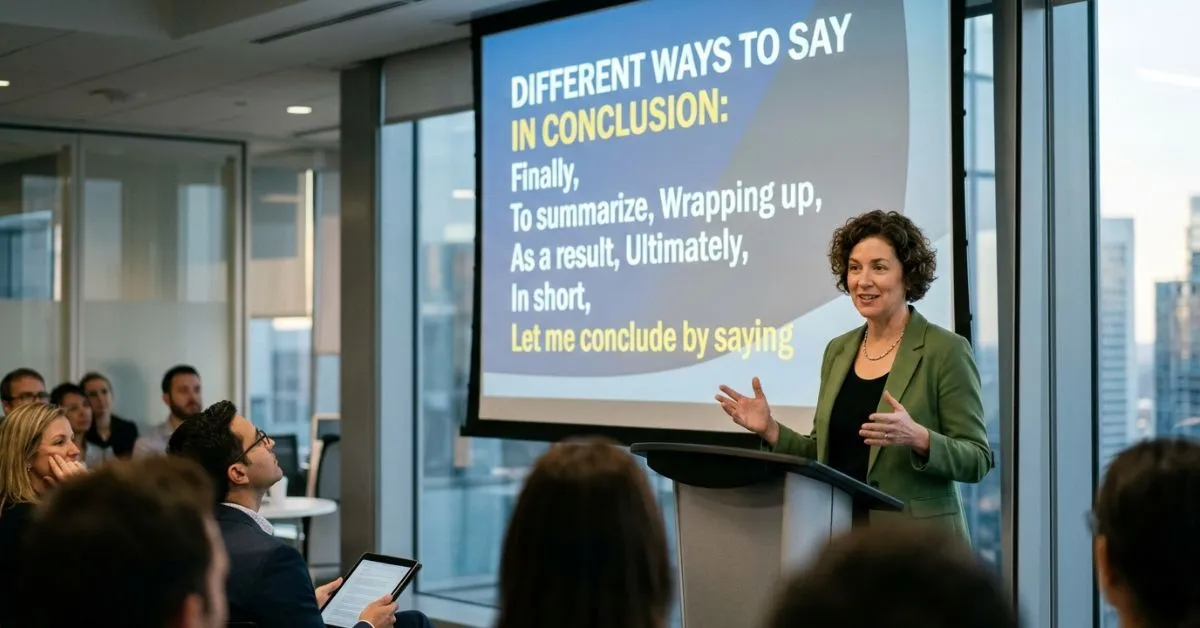
Every writer, speaker, or student has faced the challenge of ending their work smoothly. Saying the same phrase over and over, like in conclusion, can feel boring and repetitive. Choosing the right way to wrap up your thoughts not only makes your writing more professional but also keeps your readers engaged.
If you’re writing an essay, preparing a speech, or crafting a blog post, having a variety of alternatives makes your conclusion feel fresh and confident. In this guide, we’ll explore different ways to say in conclusion across multiple contexts, with practical examples you can use right away.
Academic Writing 💼
When you’re writing essays, research papers, or formal reports, it’s important to conclude your ideas clearly and professionally. Here are alternatives for academic settings:
- To summarize
- In summary
- Overall
- To conclude
- As a final point
- In brief
- In essence
- To sum up
- All in all
- Ultimately
- In retrospect
- Taking everything into account
- In final analysis
- In short
- As shown
- Considering all factors
- In review
- As highlighted above
- To encapsulate
- To wrap up
These phrases help your reader understand that you are finalizing your argument or findings.
Business & Professional Writing 💼
In business reports, emails, or presentations, your closing statements need to feel concise and persuasive. Here are alternatives suitable for a professional audience:
- Moving forward
- As a takeaway
- To put it briefly
- To sum things up
- All things considered
- To close
- Bottom line
- Key points to remember
- In final consideration
- In short order
- To draw a conclusion
- To finish
- The main takeaway
- In reflection
- As outlined
- Taking everything into consideration
- Conclusively
- In the final analysis
- Summing it all up
- In the long run
Using these alternatives makes your writing sound polished and strategic while avoiding repetitive phrasing.
Creative & Humorous Writing 🎨
If you want your conclusion to entertain, inspire, or feel more personal, these fun and dynamic alternatives can make your ending memorable:
- That’s a wrap
- To bring it home
- All roads lead here
- And there you have it
- The final word
- Mic drop
- Last but not least
- To put a bow on it
- In a nutshell
- In the grand finale
- To cap it off
- Mission accomplished
- To seal the deal
- As fate would have it
- In closing thoughts
- Wrapping things up
- End of the line
- In short and sweet
- To finish strong
- Cue the credits
These expressions add personality, humor, or drama, perfect for blogs, speeches, or social media posts.
Email & Messaging ✉️
When writing emails or messages, your conclusion should be polite, professional, and clear. Here are alternatives for closing emails or chat messages:
- Looking forward
- To summarize briefly
- All in all
- In closing
- As discussed
- To recap
- In short
- As mentioned
- To finish up
- To put it briefly
- Best regards
- In reflection
- Wrapping up
- Final thoughts
- Key points
- Taking everything into account
- To finalize
- In review
- To conclude briefly
- Quick recap
Speech & Presentation 🗣️
Concluding speeches or presentations requires phrases that signal your audience that your talk is wrapping up. Here are 20+ engaging options:
- To wrap things up
- In conclusion
- Finally
- Let me leave you with
- To end on a high note
- In closing
- To sum it all up
- To finish
- As a final thought
- Bringing it all together
- To conclude
- As highlighted today
- The main takeaway
- Last but not least
- In the final word
- To summarize
- To cap off
- In review
- All things considered
- To leave you thinking
Storytelling & Narrative Writing 📖
When telling stories or writing narratives, the conclusion can feel natural and flowing. Alternatives include:
- And that’s how it ended
- To close the story
- In the end
- So it goes
- To bring the tale to a close
- And that’s the final chapter
- In short
- That wraps it up
- All said and done
- To finish the story
- The story concludes
- To end this journey
- And thus
- That’s the gist
- To tie it together
- In retrospect
- As it turned out
- To wrap the narrative
- The end of the line
- Closing thoughts
Persuasive Writing & Arguments ⚖️
When your goal is to persuade, your conclusion should reinforce your point strongly. Alternatives include:
- Clearly
- It is evident that
- In closing argument
- As demonstrated
- To reiterate
- Therefore
- This proves that
- To underscore
- Ultimately
- As shown above
- To finish strong
- In light of this
- All evidence considered
- To wrap up persuasively
- To make the point
- Considering all factors
- In summation
- The takeaway is clear
- Conclusively
- To draw the final point
Creative Writing & Blogging ✨
For blogs, social media, or casual creative writing, you can be playful or unique with your conclusion. Examples include:
- That’s a wrap
- And scene
- To put a cherry on top
- Finishing touches
- Cue the applause
- And there you have it
- To close the chapter
- Ending on a high note
- Mic drop moment
- To sum it up
- That’s all she wrote
- Wrapping it with flair
- To seal the deal
- And boom, done
- Last words here
- To bring it full circle
- Ending thoughts
- In the final stretch
- To finish fabulously
- And finally
Concise & Quick Options ⏱️
Sometimes you just need a short, punchy phrase to conclude a paragraph or presentation. Here are 20 quick alternatives:
- In short
- Briefly
- Summing up
- Finally
- To finish
- In essence
- To recap
- To sum
- Overall
- Conclusively
- Last word
- Bottom line
- Key takeaway
- In final thought
- To end
- As noted
- In final review
- All said
- Wrap up
- To close
These are perfect when space or time is limited.
Tips for Using Different Ways to Say In Conclusion ✅
- Match tone to context: Use formal phrases in essays, professional ones in business, and creative ones for casual writing.
- Avoid overusing: Rotate alternatives to keep your writing fresh.
- Placement matters: Ensure your conclusion clearly signals the end of your message.
- Combine with summary: Use a concluding phrase along with a brief recap of key points.
- Be natural: Choose alternatives that feel like your own voice.
Conclusion
Mastering different ways to say in conclusion can elevate your writing and speaking, making your endings feel strong, polished, and engaging. From academic essays to casual blogs, having a wide range of options ensures you never sound repetitive.
Try mixing formal, professional, creative, and concise alternatives depending on the situation. Which of these phrases will you try in your next piece of writing?
Discover More Article
- Master Writing: Another Way to Say In Conclusion 📝 Effortlessly (2026)
- Upgrade Your Writing: Another Way to Say Impact ✨ (2026)
- Better Way to Say in Conclusion ✨ Make Your Writing Shine (2026)

I am Lewis Carroll, a passionate writer with 4 years of experience. I create clear, engaging content on English grammar and writing tips at Responsze.com. My goal is to help readers improve their language skills while making learning simple, enjoyable, and effective for everyone.