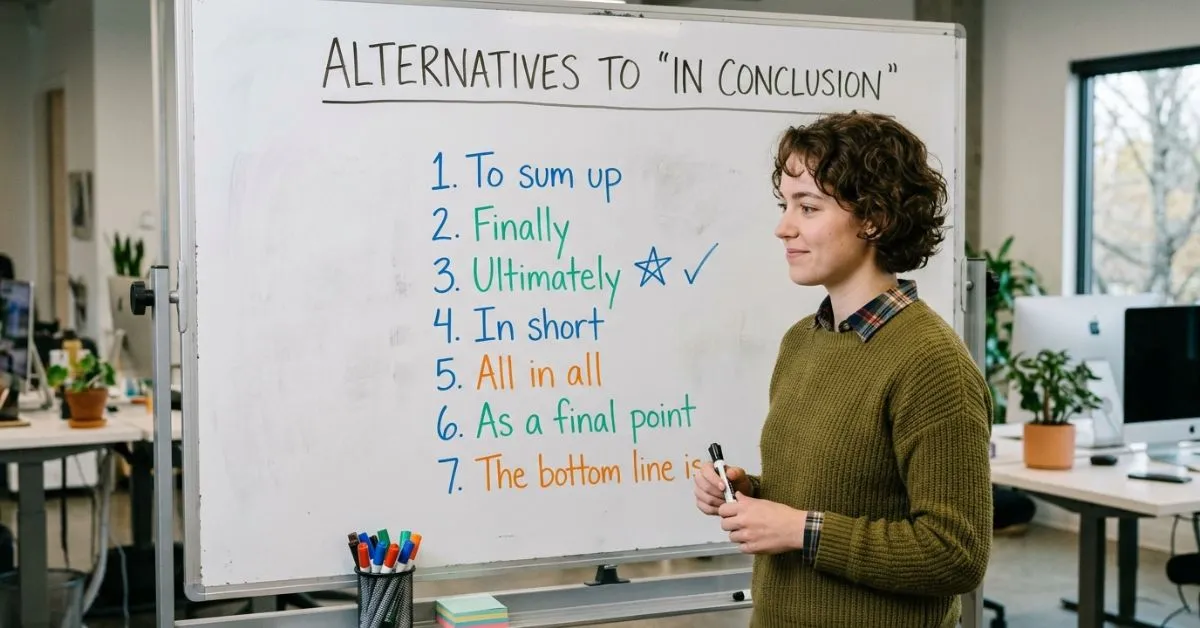
Ending an essay, speech, or email can feel tricky. We often reach for in conclusion, but repeating it too much can sound dull or formal. Using fresh alternatives can make your writing or speaking more engaging and polished.
If you’re a student, professional, or casual communicator, knowing different ways to wrap up helps you leave a strong impression. In this guide, you’ll discover multiple options for saying in conclusion, organized by context, style, and tone so you can use them naturally.
Academic or Formal Writing
In essays, research papers, or presentations, formal alternatives to in conclusion can make your work more professional and varied.
- To summarize
- In summary
- To sum up
- In essence
- Overall
- In brief
- In short
- To encapsulate
- Ultimately
- In final analysis
- To review
- In recapitulation
- All things considered
- In total
- To bring together
- To close
- In retrospection
- As a final point
- As a final thought
- In the end
- Taking everything into account
- After all considerations
Business or Professional Communication
Emails, reports, and presentations need polished, concise endings that convey authority without being repetitive.
- Moving forward
- In closing
- To wrap up
- As a summary
- To conclude
- Wrapping things up
- Finally
- To finalize
- As we finish
- To put it all together
- Bringing this to a close
- To end on a note
- As the final step
- As a takeaway
- For final consideration
- As a final remark
- In light of these points
- To draw a close
- Conclusively
- All considered
- As an executive summary
Creative, Humorous, or Emotional Context
Sometimes, you want to end with a playful, personal, or emotional touch. Here are ways to creatively say in conclusion:
- At the end of the day
- And that’s a wrap
- To cut a long story short
- To bring it home
- To put the cherry on top
- To tie it all together
- And boom, that’s it
- So there you have it
- In the grand finale
- To sum it with a bow
- That’s the long and short of it
- Wrapping it with a smile
- To close the curtain
- In closing thoughts
- To cap it off
- And there we go
- To finish strong
- In the final act
- In the end, my friends
- To bring down the curtain
- That’s all she wrote
Conversational or Everyday Use
For casual chats, texts, or social media posts, you don’t need formal phrasing. These alternatives make your conversation sound natural:
- To sum things up
- All said and done
- So yeah
- That’s about it
- To bring it all together
- And there you go
- In short
- That’s basically it
- To put it simply
- And that’s the gist
- All wrapped up
- In conclusion, basically
- To keep it simple
- To finish off
- So in the end
- That’s the bottom line
- To tie things up
- As a final note
- That’s all for now
- To round it out
Public Speaking or Presentations
When you’re speaking to an audience, endings need to feel confident and memorable. These alternatives work well:
- Let me leave you with this
- In closing remarks
- To finish my point
- As I conclude
- Bringing this to a close
- To wrap things up
- Let’s summarize
- To recap briefly
- In the final analysis
- To conclude today
- As a takeaway
- As we finish
- Finally, remember
- Wrapping up my talk
- To end my presentation
- To draw conclusions
- Let me summarize briefly
- In essence, what matters
- As my last point
- To end with clarity
Writing for Blogs and Content Creation
Blog posts, newsletters, and online articles need endings that engage readers and encourage action:
- To recap key points
- In summary, we learned
- Bottom line is
- To close this post
- Wrapping up this article
- To finish off this topic
- In short, here’s the takeaway
- Key points to remember
- All in all, the idea is
- To bring it together
- To leave you with this thought
- In conclusion, don’t forget
- The main takeaway is
- To end on a high note
- Wrapping up for today
- To finish strong
- In essence, remember this
- Here’s the summary
- As we conclude this read
- To conclude and act
Persuasive or Argumentative Writing
When convincing someone or summarizing arguments, these alternatives help make a strong final point:
- As the evidence shows
- Therefore
- Thus
- Consequently
- The conclusion is clear
- Given these points
- All things considered
- In light of this
- From this, we can see
- Hence
- To sum the argument
- Looking at the facts
- As demonstrated
- This proves that
- Considering everything
- The bottom line is
- In final analysis
- Clearly
- As such
- Ultimately, we see
Creative Writing or Storytelling
Writers can end stories, essays, or poems with flair using these expressive alternatives:
- And so it ends
- The story closes
- In the final chapter
- To bring the tale to a close
- And that’s the journey
- To wrap up the narrative
- In the last scene
- To finish the tale
- To conclude the adventure
- Thus our story ends
- To tie up the threads
- And that’s how it goes
- In the end, all was well
- To close the story
- To finish the saga
- That’s the tale in brief
- To end on a note of hope
- To bring the story home
- As the story concludes
- And that’s the last word
Short and Concise Options
If you want quick, punchy alternatives for fast writing or casual messaging:
- Bottom line
- All in all
- To sum
- Simply put
- To finish
- End of story
- In sum
- Quick recap
- That’s it
- To close
- In brief
- Sum total
- Wrap-up
- To finalize
- Short story
- Final word
- As noted
- Overall point
- To recap
- Last thought
Tips for Using Alternatives to In Conclusion
- Match tone with context: Use formal alternatives for professional work and casual ones for personal writing.
- Avoid overuse: Rotate phrases to keep your writing fresh and engaging.
- Keep it natural: Some alternatives may feel forced; read aloud to check flow.
- Emphasize key points: Choose phrases that guide the reader toward your main takeaway.
- Use variety strategically: Different endings can reflect your personality or mood.
Conclusion
Saying in conclusion doesn’t have to feel repetitive or boring. By choosing from formal, professional, creative, or concise options, you can tailor your ending to suit any situation.
Experiment with these alternatives, and see which feel natural for your style. Which of these phrases will you try in your next essay, email, or speech?
Discover More Article
- Better Way to Say in Conclusion ✨ Make Your Writing Shine (2026)
- Different Way to Say In Conclusion: Academic, Business, and Creative 💼 (2026
- Boost Your Writing with Other Way to Say In Conclusion (2026)

Charles Dickens is a passionate writer with 6 years of experience, specializing in English grammar and writing tips. He shares practical advice, engaging tutorials, and language insights on Responsze.com, helping readers improve their writing skills and master clear, effective communication every day.